 clino
clino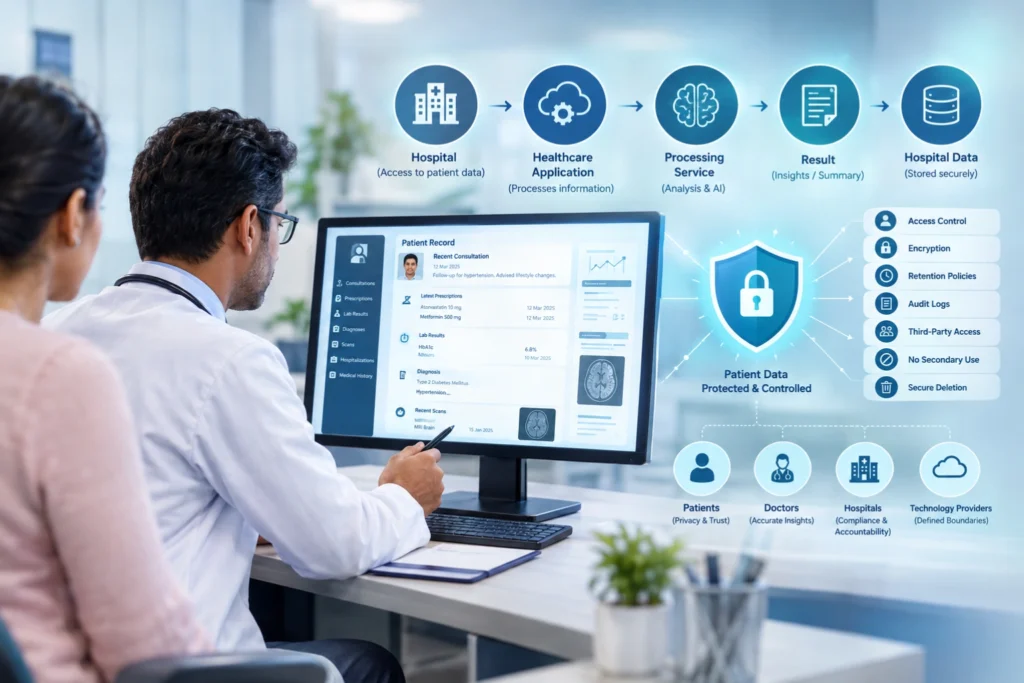
A patient goes to the hospital. The doctor looks at his/her medical record, which contains information about past consultations, prescriptions, laboratory results, diagnoses, scans and hospitalizations.
Now imagine that a software can read this information in seconds and display the most relevant information to the doctor.
It sounds great. It really can be.
But there is another question that does not get enough attention:
What happens to the patient’s medical data after the system reads it?
Is the information deleted once the task is done? Stored? Can it be viewed by someone else? Can it be used to improve the system? What happens if the software is provided by an outside company?
As healthcare becomes more connected, these questions are becoming as important as the capabilities of the technology itself.
Medical Data Is Not Ordinary Information
The patient’s medical record is not like most other pieces of information.
It has a wealth of different kinds of information about the patient’s diseases, medications, allergies, lab results, family medical history, treatments, prognosis for the future.
A patient’s record contains information from myriad sources that may have been gathered over many years.
When this information is entered into a computer for processing, it can be utilized to –
- generate a summary of the patient’s medical history,
- research similar cases and treatments,
- review medications,
- compare lab results,
- generate clinical reports,
- locate information in a huge database,
- perform administrative functions,
- and help doctors understand the patient’s treatment.
This information can save a lot of time. However, it also means that healthcare facilities need to be much more careful about how information is handled and what can access a patient’s medical records. The issue is not whether the computer can read the information. The issue is what can be done with the information after it has been read.
The Journey of Patient’s Data
It is good to think of medical information as a journey.
A doctor opens up a patient’s file. The system forwards some information to a processing service for analysis and returns a result such as a summary or extracted information. Now a number of actions can take place depending on the architecture of the system.
The information may stay inside the hospital’s healthcare system; some information may temporarily go to another service for processing and the result is stored in the patient’s record. There may also be technical logs, access records or temporary files generated during the process.
This means that a healthcare organisation should be aware of:
- what information entered the system,
- where it was processed,
- whether it was stored,
- how long it was retained,
- who could access it,
- and whether it was used for anything else.
This should not be seen as technical detail, but as part of building trust with patients.
Reading Patient Data Does not Mean Owning it
This subtle difference can have serious consequences and is easy to overlook.
A health care application may need access to patient information in order to accomplish a particular task. That does not mean that the technology provider should be able to use that information for other purposes.
For instance, a system might need access to a patient’s previous consultation notes in order to produce a clinical summary. That does not necessarily mean that those notes should then subsequently be used for other purposes.
Healthcare organisations should therefore establish clear boundaries with regard to:
- Access to data
- Storage of data
- Retention of data
- Sharing of data
- Deletion of data
- Access by third parties
- System logs
- Secondary use of information
The main principle should be simple: a system should have access to the information it needs to perform its task and nothing more
The World Health Organization has repeatedly stressed the importance of taking into account privacy, confidentiality, transparency, accountability and human control as key principles when it comes to healthcare technologies that make use of intelligent systems.
What Happens in the Case of Involvement of the Third-Party Technology Provider?
In addition, it is noteworthy that now many hospitals are not fully developing all components of technology on their own but instead are using third-party software, cloud service providers, data analytics platforms or specific applications that are designed to solve a particular set of tasks.
In such situations, understanding the entire chain of data processing steps is essential for the hospital to ensure that all the required measures are taken.
For instance, when the healthcare application is involved, the general scheme can look like this:
Hospitals → Healthcare applications → Processing service → Result → Hospital data
Where multiple components are involved, each of which must be considered when determining access to data, assessing levels of security and responsibility.
A healthcare organization should ask not only the technology provider about whether they work with personal information but also get clarification on a series of additional points.
- Where will the information be processed?
- Will it be stored anywhere after processing?
- For what period and under what conditions can the technology provider store personal information?
- Who will have access to the data?
- Will the information be transferred to any other organization?
- Will the data be used to improve the technology provider’s products or services?
- Can the technology provider use the information for any secondary purposes?
- What are the terms of information storage, use or destruction after the contract is terminated?
What About Temporary Data?
One of the least talked about areas of healthcare data management is the information which is stored temporarily.
A system may not have a patient’s entire record stored permanently, but there may be information which is present for a temporary period while a task is being carried out.
For example, a system may accept consultation notes and send back structured information after processing.
Even if the information is not to be stored permanently in the processing environment, the organisation should understand what happens during this time.
Healthcare data governance cannot just be limited to the database. The whole activity should be reviewed, including the lifespan of the information from when it is accessed until when it is no longer needed.
Can Patient Data Be Used to Improve a System?
This is another critical question.
Healthcare technology is enhanced by trial and error, and, while these are related, each is different from actually employing the technology and using the data it provides.
Therefore, if a patient’s file is ever going to be used for a purpose besides its original intent, the organization needs to be clear about what they are going to do with it. This is especially important in systems that are capable of using big data to improve itself.
The patient shouldn’t have to wonder what happens to their data once they entrust it to the healthcare organization, and the organization shouldn’t be afraid to detail what they do with it.
The World Health Organization issued a warning regarding healthcare technology that could put patients at risk of exposure of their confidential information due to insufficient control or lack of transparency in its application.
The Doctor Still Needs to Know What Happened
There is another side to the issue. Say that a system was able to read through a patient’s past records and produce a summary of what happened. This summary could save a doctor a lot of time.
However, the doctor would need to be able to determine the information that came from where, and read through it before applying it. It‘s important that an automatically generated summary could misinterpret something. Healthcare is not one of those fields that speed comes before being correct.
Recent conversations circling medical technology are becoming more fixated on who is accountable when automated systems are used in the workplace, not just the system producing an answer, the individual double-checking it first.
Patient Data Needs a Clear Boundary
The need of health care systems to design walls around patient data is fundamental. Within the walls are contained the information necessary for physicians and others to provide care. Outside the walls is everything else.
A variety of techniques may be employed to design and enforce these walls including:
- role-based access to information,
- authentication,
- auditing,
- encryption,
- retention,
- third party access controls,
- security reviews,
- and approval for specific clinical acts.
These walls are barriers to innovation, but at the same time, this environment is what enables innovation to occur. As these systems grow more complex, walls become more important.
India Is Becoming More Accountable In Its Healthcare Technology
India’s healthcare technology space is also becoming more responsible in its adoption of technologies
In 2026, India launched initiatives such as SAHI (Strategy for AI in Healthcare for India) and BODH (Benchmarking Open Data and Healthcare) to promote safer, more accountable use of emerging technologies in healthcare. There is an emphasis on aspects such as data governance and systems evaluation and validation
This is a welcome trend. Healthcare systems need to have technologies that have been thoroughly tested and proven in practice – not just ‘presented’ in a theoretically desirable manner Systems must be vetted for their efficacy, safety, and fitness for purpose – for the specific application and population for which they are intended.
Where Clinovexa Fits In
The same considerations, in fact, underpin the development of a connected healthcare platform of the type represented by Clinovexa.
The emphasis should therefore be less on digitisation of further information and on how this can be leveraged and more on how healthcare organisations can manage this information effectively in order to facilitate structured, accessible and useful information with appropriate safeguards in place.
Connected healthcare environments can bring together clinical records, patient history, prescriptions, investigations and operational workflows in a single environment;
when they are complemented by intelligent capabilities, these should seek to enhance the day-to-day working practices of healthcare professionals rather than form an separate and disconnected layer.
For a doctor, this could mean enhanced access to relevant patient information; for a hospital, enhanced inter-departmental coordination; for patients, a more connected experience of care.
But in all these cases, this should be without undermining the confidence that patients can have in their personal health data being managed appropriately.
The Future Is Not Just About Smarter Systems
Healthcare technology is on the brink of something special, where systems can do much more with patient information than just store it. They can organize it, summarize it, compare it, and help healthcare professionals find useful information faster.
This creates huge opportunities. It also poses huge levels of responsibility.
The future of healthcare will not be determined by how intelligent a system is, but also on how responsibly that system handles information that is entrusted with it. Patients need to know their medical information is kept confidential.
Doctors need to know where to find the most important information. Hospitals need to know who has access to their data.
Vendors should make their mechanisms known to the public. And hospitals and other healthcare organizations need to know that they will be held accountable for the systems they bring in-house.
The true test of smart healthcare isn’t how much information a system can read, but how responsibly that data is handled after it’s been read. This is where better technology and better healthcare need to meet.
