 clino
clino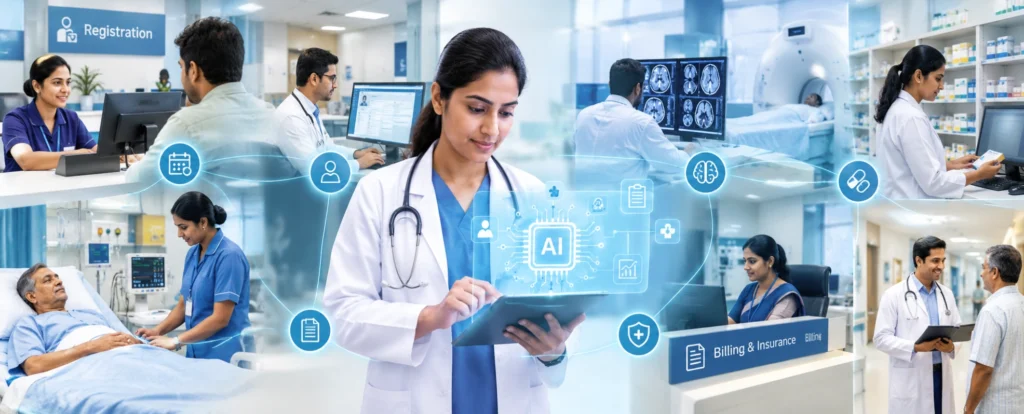
Artificial intelligence in healthcare is often talked about in terms of faster diagnosis or quicker processing of medical images and documents. But it has the potential to become embedded into the wider hospital system workflow.
There is more to an effective hospital than the doctors. There are the receptionists, nurses, laboratories, pharmacists, billers and administrators. All of them share and rely upon information.
The disjointed system wherein these hospital departments function separately, with information being shared between them in a slow, manual way, allows for delays and duplication of efforts. An AI hospital workflow can ensure that the right information flows seamlessly through the process, enabling everyone to do their part more quickly and accurately.
The key advantage of an AI hospital workflow lies in empowering the hospital staff to extract the relevant data, make it easier for everyone to collaborate and avoid wasteful tasks.
What Does AI Hospital Workflow Actually Mean?
The conventional process in a hospital involves a set of interlinked steps – registration, OPD consultation, investigations, treatment, billing and discharge. Many hospitals already digitise certain aspects of the workflow, which may consist of separate applications, spreadsheets and records.
An AI-driven hospital workflow goes deeper than that. Depending on the applications being used, artificial intelligence can aid in organisation of clinical information, analysis of operational data, identification of missing documentation, automation of routine administrative tasks and collation of relevant information for each professional in the chain.
For a doctor, that could mean being able to view past consultations, investigations or medication for a returning patient without having to trawl through multiple files.
This does not mean that the AI alone decides on the course of treatment — it is about providing the healthcare professional with the right data at the right time to make an informed decision.
Clinovexa’s [AI-powered hospital management solution]
https://clinovexa.com/ai-powered-hospital-management-software-india/
Creates a unified platform for handling patient, clinical, diagnostic, pharmacy, billing and administrative operations of the hospital.
What Are the Differences Between Hospital Operations With and Without AI?
1. Patient registration/appointment
At the reception, the patient’s information is gathered, appointment slots are identified, previous patient records are retrieved and the details are recorded. It is common for the receptionist to have to deal with multiple applications and enter the same data several times, wasting precious minutes in the process.
A connected AI hospital workflow ensures that the patient data is retained across relevant departments. Tools, where implemented, can assist with organisation of appointment requests, answering routine queries and recognising patterns of appointment scheduling.
This can ease the process for the patient and reduce duplication of effort for the staff.
2. OPD consultation and documentation
Doctors need complete patient information in order to conduct a successful consultation, including medical history, investigation results and medication. Time spent on paperwork and documentation can eat into precious minutes of doctor-patient interaction.
AI-assisted documentation tools can help organisation of the consultation notes, transcribing spoken information or preparing a draft of the notes for the doctor to approve. Clinical decision-support tools can collate the necessary documents or provide relevant suggestions, depending on the information contained in the notes and the settings of the application.
Again, such a tool is not meant to replace the doctor’s examination, analysis and treatment recommendations but to assist them in providing the most appropriate care.
Clinovexa’s Hospital Management Software: https://clinovexa.com/ai-powered-hospital-management-software-india/
Facilitates digital clinical workflow, including OPD consultations, patient information, investigations and prescriptions with AI-assisted documentation and decision support where applicable.
3. Nursing/inpatient care
Once a patient is admitted to the hospital, there is a series of observations, medication, investigations, notes and communication with the nursing staff. Each team is responsible for its own set of paper records and it takes time to read through the previous notes.
A unified inpatient workflow can ensure that the relevant information, including notes, observations, medication and investigation results, is available to the next team on shift. AI tools, where implemented, can flag missing documentation or recognise patterns which may require a physician’s intervention.
Any kind of AI-generated alert about deterioration of patient health or potential risk must be carefully scrutinised and double-checked with appropriate bedside observations before taking any action.
4. Laboratory/pathology/radiology
Investigations are an integral part of modern-day healthcare but they only have value if the results are delivered in a timely manner and interpreted correctly. The staff in the lab or imaging department may have to follow up on pending tests or forward the reports to the treating team, increasing the chances of miscommunication.
With a connected diagnostic workflow, the requests and reports are linked to the patient’s file. AI can assist in some of the image analysis, prioritising selected findings for review or flagging operational issues with the process.
The reality, however, remains that AI does not guarantee better speed of a test, it only supports the interpretation of results within the larger clinical context.
5. Pharmacy/prescriptions/inventory
The functioning of a pharmacy covers processing of prescriptions, dispensing medication, maintenance of inventory, batch numbers and expiry dates. When these are managed separately from clinical and billing operations, the staff has to spend considerable time tracking down the relevant information.
A unified pharmacy workflow can collate the prescriptions, dispensing, inventory and billing activities. Depending on the capabilities of the application, AI or other rule-based tools can recognise patterns of low inventory, forecast demand or flag selected information for the pharmacist’s attention.
Alerts to medication-related issues require special care — an AI application cannot confirm or deny an interaction or dosage, it can only flag the possibility for review by an appropriately qualified human professional.
Clinovexa’s [Pharmacy Billing and hospital management capabilities]
https://clinovexa.com/ai-powered-hospital-management-software-india/
To help unify the management of pharmacy, inventory and billing processes.
6. Billing/insurance/discharge
Discharge from the hospital involves coordination between the doctors, nursing, investigation, pharmacy and billing departments. The process may be held up due to pending investigation results, missing documentation or unresolved billing issues. An integrated workflow makes it possible for the concerned team to view the status of pending tasks and have relevant clinical and financial information at their fingertips. AI-assisted administrative tools can collate some of the necessary documents, highlight relevant sections, identify patterns or suggest solutions.
Billing and insurance claims remain a financial activity — they have to be reviewed against actual services availed and applicable policies. Similarly, an AI-generated summary of discharge cannot simply be approved by a doctor; it has to be reviewed and confirmed by the appropriate clinical professional.
By streamlining the communication between departments, the hospital staff can spend less time chasing documents from each other and more time on their actual areas of responsibility.
AI Hospital Workflow vs Conventional Operations
AI in itself does not make a hospital better than one without it. The advantages of an AI hospital workflow only come when the technology is making a real difference to everyday operations.
| Conventional or disconnected workflow | Connected workflow with suitable AI support |
| Staff may enter the same information repeatedly. | Shared digital records can reduce duplicate entry. |
| Patient information may be spread across separate systems. | Authorised teams can access relevant connected records. |
| Documentation relies heavily on manual preparation. | AI may assist with drafts, summaries and structured notes. |
| Pending tasks often require manual follow-up. | Workflow tracking and configured alerts can highlight outstanding tasks. |
| Managers review reports from separate departments. | Integrated dashboards can provide a broader operational view. |
| Staff manually identify some recurring operational patterns. | Analytics and validated AI tools may help identify trends for review. |
The distinction is crucial because a simple digitisation of operations can bring about improvements without artificial intelligence. AI adds value only when it is doing something better than the conventional approach.
What Does This Mean for Doctors, Patients and Administrators?
For physicians, the most valuable aspect of an integrated hospital workflow with AI is the ability to view the relevant patient data without duplication of information and reduce documentation efforts. It can help conserve doctor-patient time, but only if the application is easy to use and appropriate for the setting.
For patients, the advantages of a connected AI workflow can include better inter-department coordination, smoother administrative processes and easier follow-up. It does not necessarily mean faster treatment but better clarity of the process.
For hospital administrators, the ability to view a larger set of operational data can help them understand trends in admissions, occupancy, pending tasks, billing and other factors. AI tools can add value by analysing the data to recognise patterns, but it is up to the manager to examine them in the clinical context.
The benefits described above only come if the technology is deployed appropriately with valid data, proper staff training and relevant integration with existing activities.
Can AI Be Effective Across the Hospital Without Introducing New Risks?
An enterprise-level AI application requires more than just implementation. The data has to be handled confidentially, access controlled, and applications tested for suitability.
Hospitals considering AI need to evaluate:
– Clinical validation: Has the application been tested for its intended purpose and patient category?
– Human oversight: Who among the staff is responsible for critical decisions and actions?
– Data privacy: Are appropriate security, privacy and compliance measures in place?
– Integration: Does the technology fit in with the existing process flow?
– Monitoring: Are there processes in place to review errors and feedback?
The World Health Organization has emphasised the importance of safety, transparency, accountability, and human oversight in the application of AI for health. These considerations are of particular importance when the technology is involved in clinical decision-making or handling confidential patient data.
Clinovexa also covers the essential groundwork for connected and integrated healthcare through its paperless healthcare solution-
https://clinovexa.com/paperless-ai-healthcare-for-hospital-and-clinic/
and data security and compliance resources- https://clinovexa.com/healthcare-data-security-compliance-india/.
How Clinovexa Fits into the AI Hospital Workflow
Clinovexa covers hospital and clinic management, pathology, radiology, and pharmacy operations within its healthcare platform. The objective is to bring better coordination across the patient’s journey from admission to consultation, investigation, treatment, billing and follow-up.
For hospitals exploring the use of AI, the immediate consideration is to recognise the areas where staff spends excessive time and effort on data entry, retrieval, documentation or coordination. Then determine if integration of information or introduction of AI is a more viable solution in that particular context.
It is possible that in some cases ordinary software tools are sufficient, while in others automation with AI capabilities is more advantageous.
A hospital needs to evaluate an AI solution based on real-world performance against suitable metrics such as documentation time, pending tasks, report turnaround time, billing errors, staff workload. Patient experience. Clinical safety and quality of care have to remain a priority.
Question & Answers
Does AI hospital workflow mean that the hospital can operate without humans?
Not even close. AI can assist in some of the administrative, analytical and clinical-support activities but doctors, nurses, pharmacists, and other professionals continue to play an irreplaceable role. All clinical actions need to be performed with appropriate human oversight.
Can AI hospital workflow help shorten waiting time?
It can play a part in reducing waiting time by enabling better appointment coordination, reducing administrative delays and helping identify bottlenecks. But it is not the only factor — there are numerous other considerations such as volume of patients, staffing, emergencies and equipment.
Is a hospital management system the same thing as AI hospital workflow?
Not quite. A hospital management system is about organisation of operations and integration of information between departments. An AI-assisted hospital workflow goes deeper to assist with documentation, organisation and analysis. A hospital can benefit from an integrated management system without AI.
How can a hospital start using AI?
It should start with a clearly defined objective, such as reducing documentation time or minimising gaps in communication.↻ Evaluate the data, requirements, privacy and risks, followed by a controlled trial run in an appropriate setting.
Conclusion
When AI is integrated into the overall hospital workflow, it can have far-reaching effects beyond the immediate applications. It can help the healthcare team utilise patient data more effectively, enable smoother inter-departmental coordination, save time on documentation and administrative tasks, and identify opportunities for improvement.
The fundamental requirement for any AI hospital workflow continues to be a unified and dependable healthcare system. AI cannot overcome inaccuracies, gaps or deficiencies in the clinical process.
Clinovexa’s healthcare platform is built around integrated operations that can enable the adoption of appropriate AI activities. The focus is on empowering the hospital staff with valuable information and saving time on non-essential tasks, thus helping them provide the best possible care to the patients.
